


Introduction
Every time a customer orders from your store, at least two types of logistics kick in before the package reaches their door. Most D2C sellers manage these daily without knowing what each is called or how it affects their costs and delivery performance.
There are two frameworks worth knowing: the direction goods move (inbound, outbound, reverse) and who handles the movement (1PL through 5PL). This blog breaks down all types of logistics, with examples tailored to Indian ecommerce sellers.
What Are the Types of Logistics?
The types of logistics are distinct operational models that define how goods move through a supply chain, with each determined by either the direction of movement (inbound, outbound, or reverse) or the level of outsourcing (1PL through 5PL).
Think of them as two separate questions your business needs to answer.
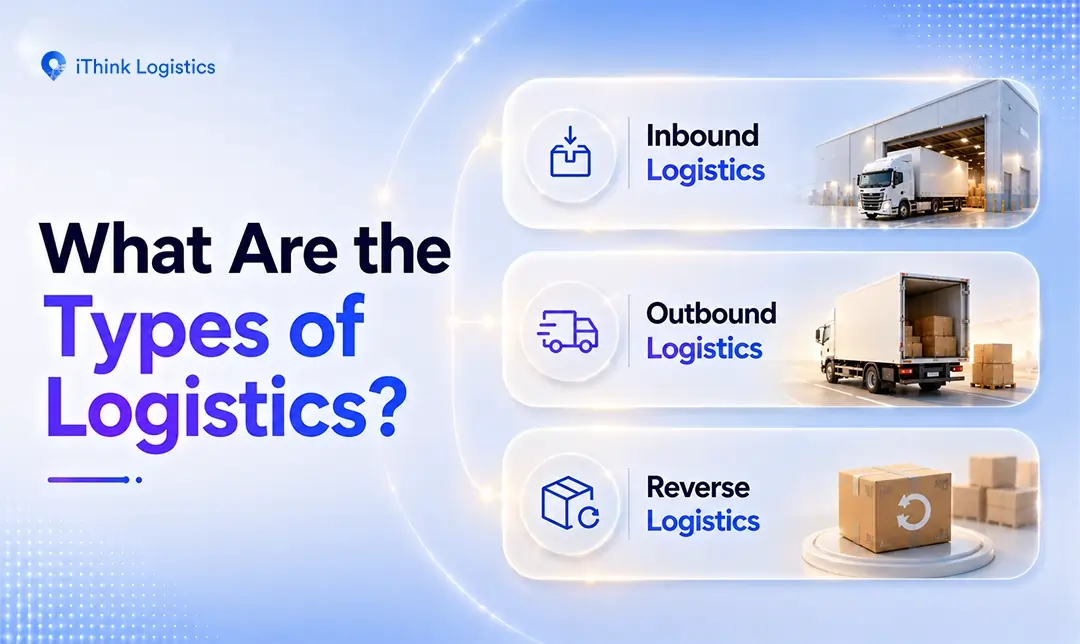
The first: Which direction are your goods moving? Goods coming into your warehouse from suppliers are inbound. Orders going out to customers are outbound. Products returned by customers are reversed.
The second: who is managing that movement? You handle it yourself (1PL), you hire a carrier for one leg (2PL), you outsource fulfillment entirely (3PL), someone manages your 3PLs for you (4PL), or a platform aggregates your shipping across multiple couriers for better rates (5PL).
Let’s break down each type with real examples.
Inbound Logistics
Inbound logistics is the process of getting goods from your supplier into your warehouse. It starts with placing a purchase order and ends when the stock is shelved and ready to ship.
This covers procurement, freight booking, stock receipt, quality checks, and inventory updates. All of this happens before a customer even places an order.
For a D2C seller in India, inbound logistics looks like this: you run low on a bestselling kurta. You place an order with your Surat supplier. The supplier dispatches the stock via surface freight. It arrives at your warehouse in 3 days. Your team checks quantities, updates your inventory system, and the SKUs go live. That entire sequence is inbound logistics.
If inbound fails, you feel it later. Late supplier dispatch? You run out of stock. Stockouts during a sale? Lost revenue and canceled orders. Nail your inbound, and your outbound keeps moving.
Once stock hits your shelves, outbound starts.
Outbound Logistics
Outbound logistics is the process of fulfilling customer orders. It covers picking, packing, dispatching, and delivering finished goods from your warehouse to the customer’s doorstep.
It starts when an order comes in. It ends when the customer gets their package.
For a D2C seller, the flow looks like this. A buyer places an order on your Shopify store at 11am. Your team picks the SKU, packs it, prints the label, and hands it to the courier by 5pm. The courier picks it up, moves it through their network, and delivers it in 2 to 4 days. That entire sequence is outbound logistics.
Your customer does not care about your inbound process. They care about this one. A slow pick-pack means a late dispatch. A wrong courier means extra transit days. Both end up in your reviews before you even know there is a problem.
Keep the outbound process quick, and customers return. Let it slip, and they won’t.
But not every order makes it. When shipments return, reverse logistics takes over.
Reverse Logistics
Reverse logistics is the process of moving goods backward through the supply chain. It covers customer returns, RTOs (return to origin), repairs, refurbishments, and recycling.
Most guides talk only about returns. For Indian D2C sellers, RTOs are the real headache.
An RTO happens when a courier cannot deliver an order. The customer was unavailable, the address was wrong, or the buyer refused the package. The courier marks it undelivered and ships it back to you. You pay the outbound shipping cost. You pay the return shipping cost. The product sits unsold in your warehouse.
In Indian fashion and apparel, RTO rates are among the highest in e-commerce. That means a significant chunk of your shipments come back before a customer ever opens them.
This is why NDR management matters. “NDR” means “non-delivery report.” When a courier marks an order as undelivered, a good NDR system calls the buyer, investigates the issue, and attempts redelivery before it becomes an RTO. Most D2C sellers ignore this tool.
Reverse logistics is not just about handling returns cleanly. It is about stopping unnecessary ones before they happen.
Now that the three directional types are clear, the next question is who manages them. That is where the 1PL-to-5PL framework comes in.
Who Actually Handles Your Shipments? 1PL to 5PL
This framework answers one thing: who runs your logistics?
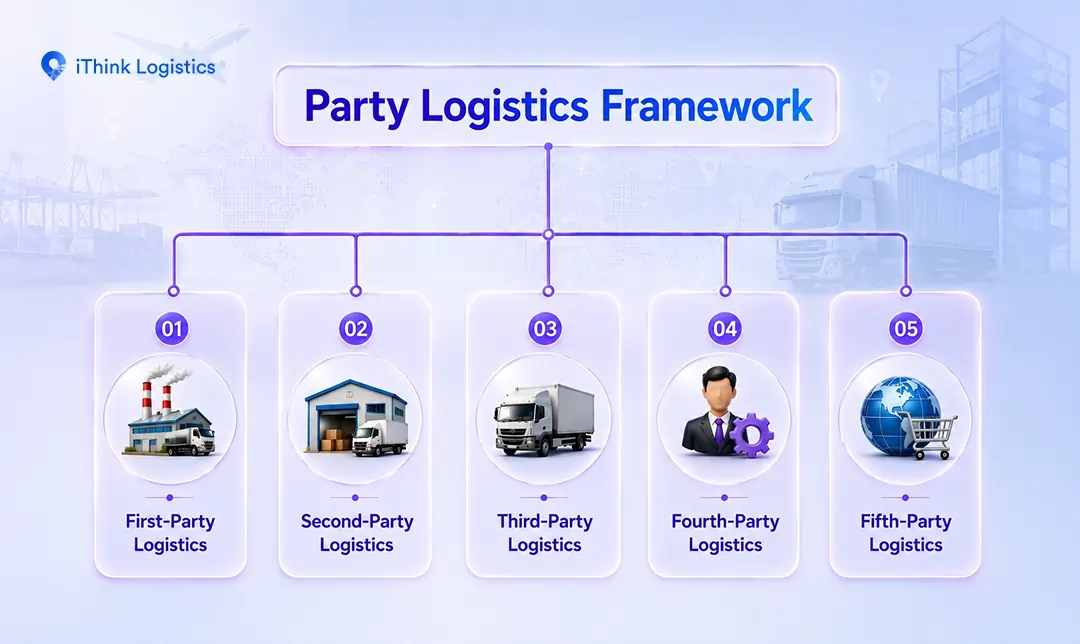
Each level adds a layer of outsourcing. Most D2C sellers in India operate on a 2PL or 3PL model without realizing it.
1PL: First-Party Logistics
1PL means you do everything yourself. You own the vehicles, run the warehouse, and control every step. No outside help.
This works when your operation is large enough, consistent enough, and concentrated enough in one geography to justify it. A brand operating its own delivery fleet in a single city is a 1PL operation. For most D2C sellers, this model is too capital-heavy to be practical.
2PL: Second-Party Logistics
2PL means hiring an asset-based carrier to handle one part of your supply chain. They own the vehicles & infrastructure. You pay for the transportation, not for the entire management.
A surface freight company moving bulk stock from your Surat supplier to your warehouse in Mumbai is a 2PL arrangement. You are not outsourcing fulfillment. You are paying for transport. Most sellers use 2PL for inbound freight without naming it that.
3PL: Third-Party Logistics
3PL means outsourcing your warehousing, fulfillment, and shipping to an external provider. The 3PL stores your inventory, picks and packs orders, and dispatches them through their courier network.
You focus on selling. They handle the rest. This works when your orders outgrow your setup, but you’re not ready for your own warehouse or don’t want warehouse management.
For example, a skincare brand in Bangalore stores its inventory at a 3PL warehouse in Mumbai. Orders placed on the website get picked, packed, and shipped without you touching a single box.
You know, iThink Logistics is also a 3PL. Here we connect you to 25+ courier partners on our platform with automated courier allocation, NDR management, and real-time tracking, so you get the rate access and flexibility of multiple couriers without managing each one separately.
4PL: Fourth-Party Logistics
4PL means outsourcing the management of your entire supply chain to a single provider. The 4PL does not just run operations. It manages your 3PLs, carriers, technology, and strategy.
Think of 4PL as your supply chain manager, sitting above all your logistics partners.
A fashion brand shipping across 15 states works with 6 courier partners, 2 warehouse operators, and multiple freight vendors. A 4PL coordinates all of them under a single dashboard, a single invoice, and a single point of contact. The brand stops managing logistics and starts reviewing reports.
4PL works best when your supply chain is complex and managing your vendors takes more time than growing your business.
5PL: Fifth-Party Logistics
5PL is an enterprise-level model in which a technology platform orchestrates multiple supply chains, 3PL networks, and freight systems simultaneously using AI, automation, and big data.
Unlike a 3PL that manages your shipments, a 5PL manages whole logistics ecosystems for many businesses. It pools demand from large corporate clients to negotiate bulk rates across global carrier networks, warehouses, and freight channels.
Picture a multinational brand shipping to 20 countries using a single AI system. That’s the 5PL scale. For most Indian D2C sellers, a 3PL aggregator offers the same core benefits, but tailored to your business.
Conclusion
Every order you ship touches at least one of these logistics types. Most touch three or four.
Knowing the framework helps you spot where your operation leaks. Slow inbound causes stockouts. Weak outbound inflates delivery times. High RTOs drain margin on every return.
If you are a D2C seller looking to tighten logistics without building infrastructure from scratch, start with a 3PL aggregator.
Which logistics type is your biggest challenge right now? Drop it in the comments.
FAQs
Q.1: How many types of logistics are there?
A: There is no single fixed number. The most practical way to count is by framework. By direction of flow, there are 3 types: inbound, outbound, and reverse. By outsourcing model, there are 5 levels: 1PL through 5PL. Add specialist types like e-commerce logistics, cold chain, and green logistics, and the total goes beyond 10. Most businesses use 3 to 4 simultaneously.
Q.2: What are the 4 types of logistics?
A: The 4 most commonly cited types are inbound, outbound, reverse, and third-party logistics (3PL). This framing comes from the supply chain management view of how goods flow and who handles them. Some frameworks replace 3PL with distribution logistics as the fourth type. Both are valid depending on context.
Q.3: What is the difference between inbound and outbound logistics?
A: Inbound logistics manages goods coming into your business from suppliers to your warehouse. Outbound logistics manages goods going out from your warehouse to the customer. Inbound focuses on procurement and receiving. Outbound focuses on order fulfillment and delivery. Both share warehouse space but serve opposite ends of the supply chain.
Q.4: What is the difference between 3PL and 4PL?
A: A 3PL handles physical execution: warehousing, picking, packing, and shipping. A 4PL manages the layer above that. It coordinates your 3PLs, carriers, and technology on your behalf. With a 3PL, you outsource operations. With a 4PL, you outsource the management of those operations. Most D2C sellers need a 3PL. 4PL suits brands with complex, multi-vendor supply chains.
Q.5: What is a logistics aggregator, and how is it different from a 3PL?
A: A logistics aggregator connects your store to multiple courier companies through one integration. You get access to several couriers, compare rates, and allocate shipments automatically without managing each courier relationship separately. A traditional 3PL owns or operates a warehouse and fulfillment infrastructure. A logistics aggregator does not. It sits at the courier access layer, not the warehousing layer.
Q.6: What is 2PL in logistics?
A: 2PL stands for second-party logistics. It means hiring an asset-based carrier to move goods for one specific leg of your supply chain. The carrier owns the vehicles or infrastructure: a shipping line, airline, or surface freight company. You pay for the transport, not full logistics management. Most Indian D2C sellers use 2PL for inbound freight from the manufacturer to the warehouse without realizing it has a name.
Q.7: What are the types of logistics in supply chain management?
A: In supply chain management, logistics is split by stage rather than direction. The main stages are procurement logistics (sourcing raw materials), production logistics (moving goods within manufacturing), distribution logistics (moving finished goods to market), sales logistics (delivering to the end customer), and reverse logistics (handling returns). These stages map to different parts of the same product journey, from the factory to the customer.
Q.8: What is reverse logistics, and why does it matter for D2C sellers in India?
A: Reverse logistics is the process of moving goods backward through the supply chain from the customer back to the seller or warehouse. For Indian D2C sellers, the bigger problem is RTOs. Every RTO incurs both outbound and return shipping fees for the seller. Managing reverse logistics well means reducing RTOs through NDR follow-ups before they trigger and processing genuine returns fast enough to resell the inventory.
Q.9: What is the difference between 3PL and 5PL?
A: A 3PL handles logistics for one business: warehousing, fulfillment, and shipping. A 5PL operates at an entirely different scale. It orchestrates entire supply chain networks across multiple companies using AI, automation, and big data. 5PL is built for large enterprises and global marketplaces, managing distribution across multiple countries. For most Indian D2C sellers, a 3PL or 3PL aggregator covers everything they need.
Q.10: Which type of logistics should a D2C seller in India start with?
A: Start with a 3PL aggregator for outbound. It gives you access to multiple couriers from one platform without negotiating individual contracts. As volumes cross 500 orders a month, move to a 3PL fulfillment center and set up NDR management to keep RTOs under control.
Authors



Thank you for your articles that you have shared with us.